 Adiyogashala
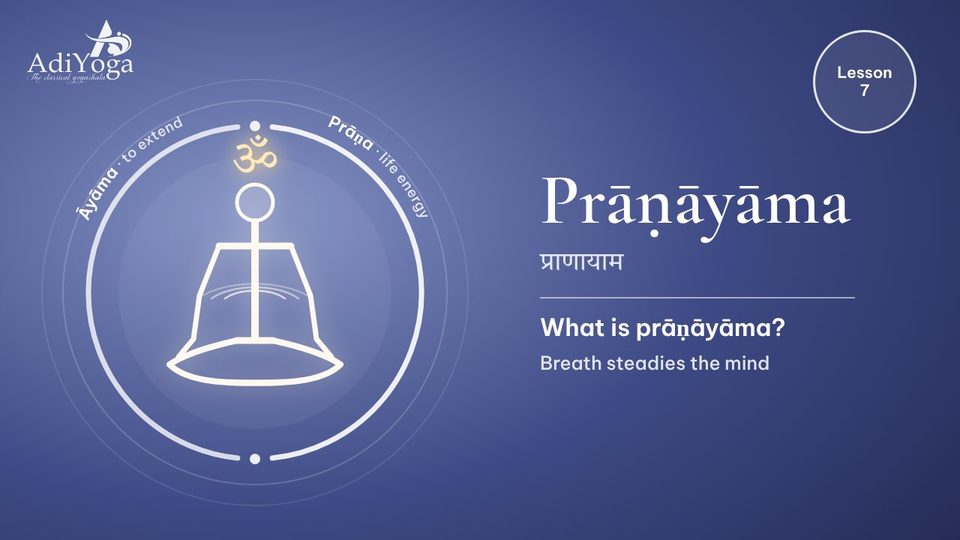
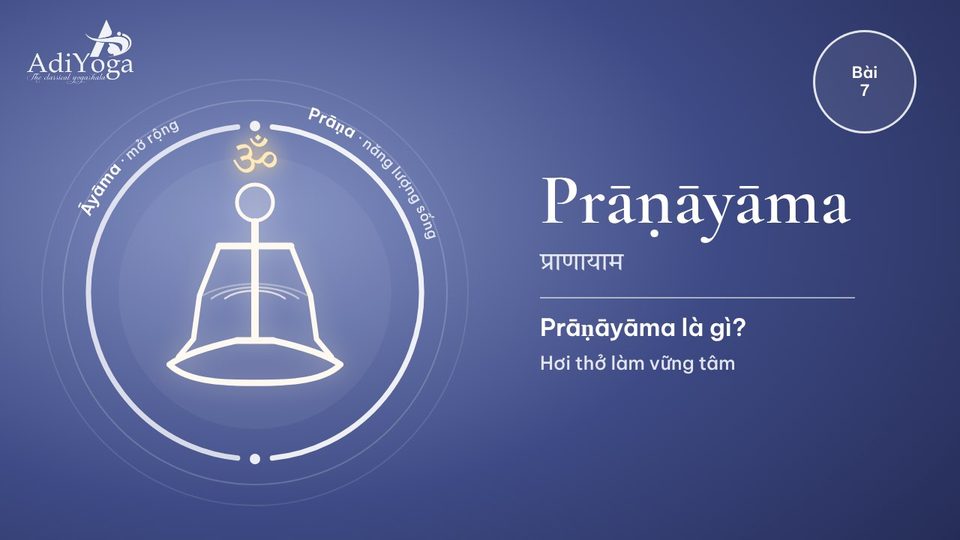
What is prāṇāyāma? · Full guide
Prāṇa and āyāma, Patañjali’s fourth limb, the parts of a breath, and how to begin safely
Prāṇāyāma là gì? · Bản đầy đủ
Prāṇa và āyāma, nhánh thứ tư của Patañjali, các phần của hơi thở, và cách bắt đầu an toàn
More than breathing exercises
We breathe about twenty thousand times a day without noticing. Prāṇāyāma begins the moment we notice, and then gently guide, this breath. Through the breath it works on the energy (prāṇa), and through the energy, on the mind.
This guide looks at the word, at what Patañjali and the Haṭha Yoga Pradīpikā teach, at the parts of a breath, and at how to begin safely.
1 · The word
Prāṇāyāma joins two words. Prāṇa is life energy, the force that moves in everything living; the breath is its most visible movement. Āyāma means extension, expansion. Read as prāṇa + yama, it also means control, restraint.
the conscious lengthening and regulation of the breath, so that life energy expands and steadies.
2 · Why the breath? The mind follows it
योगी स्थाणुत्वमाप्नोति ततो वायुं निरोधयेत् ॥
yogī sthāṇutvam āpnoti tato vāyuṃ nirodhayet
When the breath moves, the mind moves. When the breath is still, the mind is still. The yogi becomes steady; therefore regulate the breath.
Notice it yourself: when you are anxious the breath is fast and high; when you are calm it is slow and low. We cannot order the mind to be quiet, but we can slow the breath, and the mind follows.
3 · Patañjali: the fourth limb
In the eight limbs, prāṇāyāma comes after āsana. First the body must be steady.
When the posture is steady, prāṇāyāma is the regulation of the flow of inhalation and exhalation.
It has outer, inner and suspended movements, observed by place, time and number, and becomes long and subtle.
धारणासु च योग्यता मनसः ॥
dhāraṇāsu ca yogyatā manasaḥ
Then the covering over the inner light is thinned, and the mind becomes fit for concentration.
Prāṇāyāma is the bridge between the outer limbs (body) and the inner limbs (concentration, meditation).
4 · The Haṭha Yoga Pradīpikā: slowly, with a teacher
गुरूपदिष्टमार्गेण प्राणायामान्समभ्यसेत् ॥
gurūpadiṣṭa-mārgeṇa prāṇāyāmān samabhyaset
Once the posture is firm, the yogi, self-controlled and eating moderate, wholesome food, should practice prāṇāyāma as taught by the teacher.
तथैव सेवितो वायुरन्यथा हन्ति साधकम् ॥
tathaiva sevito vāyur anyathā hanti sādhakam
As a lion, an elephant or a tiger is tamed slowly, slowly, so the breath is brought under control. Otherwise it harms the practitioner.
Never force the breath. Go step by step, within comfort, and learn the stronger practices from a teacher.
5 · The parts of a breath
Filling: slow, smooth, through the nose.
A pause with the lungs full. Only when the breath is easy.
Emptying: usually longer than the inhale. A long exhale calms the system.
A pause with the lungs empty. Learned later, with guidance.
Patañjali’s “place, time and number” means: where you feel the breath, how long each part lasts, and how many rounds. In the app this becomes your breath timer.
6 · Prāṇāyāma in your practice
Simple, natural breathing. Watch the breath without controlling it. Where everyone begins.
The soft ocean breath in the throat. Used during the kriyās.
Equal inhale and exhale for a calm, steady mind.
Alternate nostril breathing that balances the two sides, Iḍā and Piṅgalā.
The cleansing breath that empties the lungs before prāṇāyāma.
Joints and spine first, then cleansing, then rest, then breath, then meditation. The body prepares the breath; the breath prepares the mind.
7 · A 5-minute equal breath
Sit upright, shoulders soft, eyes closed. Breathe naturally through the nose.
Inhale for 4, exhale for 4. If it is easy, try 5 and 5. Keep it smooth and silent.
Let the counting go. Breathe naturally and notice how the mind feels.
- Never strain or hold the breath to the point of discomfort
- Practice on an empty stomach
- With high blood pressure, heart problems or pregnancy, avoid breath holding and ask your teacher
8 · Glossary
| prāṇa | life energy |
| āyāma | extension, expansion |
| pūraka | inhalation |
| recaka | exhalation |
| kumbhaka | breath retention |
| śvāsa · praśvāsa | in-breath · out-breath |
| dīrgha · sūkṣma | long · subtle |
| vāyu | air, breath, a movement of prāṇa |
“Yoga is not an option, it is a necessity, but yogasana can be an option.”— Master Girish, Founder, Adiyogashala
Hơn cả những bài tập thở
Mỗi ngày ta thở khoảng hai mươi nghìn lần mà không hề để ý. Prāṇāyāma bắt đầu khi ta nhận biết, rồi nhẹ nhàng dẫn dắt hơi thở ấy. Qua hơi thở, nó tác động lên năng lượng (prāṇa), và qua năng lượng, lên tâm trí.
Tài liệu này nhìn vào ý nghĩa của từ, vào những gì Patañjali và Haṭha Yoga Pradīpikā dạy, vào các phần của một hơi thở, và cách bắt đầu an toàn.
1 · Ý nghĩa của từ
Prāṇāyāma ghép từ hai từ. Prāṇa là năng lượng sống, sức sống chuyển động trong mọi sinh vật; hơi thở là chuyển động dễ thấy nhất của nó. Āyāma nghĩa là mở rộng, kéo dài. Nếu đọc là prāṇa + yama, nó còn có nghĩa là điều phục, kiểm soát.
sự kéo dài và điều hòa hơi thở một cách có ý thức, để năng lượng sống được mở rộng và vững vàng.
2 · Vì sao là hơi thở? Tâm đi theo hơi thở
योगी स्थाणुत्वमाप्नोति ततो वायुं निरोधयेत् ॥
yogī sthāṇutvam āpnoti tato vāyuṃ nirodhayet
Khi hơi thở chuyển động, tâm chuyển động. Khi hơi thở tĩnh, tâm tĩnh. Hành giả trở nên vững vàng; vì vậy hãy điều hòa hơi thở.
Hãy tự quan sát: khi lo âu, hơi thở nhanh và nông; khi bình an, hơi thở chậm và sâu. Ta không thể ra lệnh cho tâm yên lặng, nhưng ta có thể làm chậm hơi thở, và tâm sẽ đi theo.
3 · Patañjali: chi thứ tư
Trong tám nhánh của yoga, prāṇāyāma đến sau āsana. Trước hết cơ thể phải vững.
Khi tư thế đã vững, prāṇāyāma là sự điều hòa dòng chảy của hơi hít vào và thở ra.
Nó có chuyển động ra ngoài, vào trong và ngưng giữ, được quan sát theo vị trí, thời gian và số lần, và trở nên dài và vi tế.
धारणासु च योग्यता मनसः ॥
dhāraṇāsu ca yogyatā manasaḥ
Khi đó, lớp che phủ ánh sáng bên trong mỏng dần, và tâm trở nên sẵn sàng cho sự tập trung.
Prāṇāyāma là cây cầu giữa các nhánh bên ngoài (cơ thể) và các nhánh bên trong (tập trung, thiền định).
4 · Haṭha Yoga Pradīpikā: từ từ, cùng người thầy
गुरूपदिष्टमार्गेण प्राणायामान्समभ्यसेत् ॥
gurūpadiṣṭa-mārgeṇa prāṇāyāmān samabhyaset
Khi tư thế đã vững, hành giả tự chủ, ăn uống điều độ và lành mạnh, nên thực hành prāṇāyāma theo cách người thầy chỉ dạy.
तथैव सेवितो वायुरन्यथा हन्ति साधकम् ॥
tathaiva sevito vāyur anyathā hanti sādhakam
Như sư tử, voi hay hổ được thuần hóa từ từ, từng chút một, hơi thở cũng được điều phục như vậy. Nếu không, nó sẽ gây hại cho người tập.
Không bao giờ ép hơi thở. Đi từng bước, trong sự thoải mái, và học các bài mạnh hơn cùng người thầy.
5 · Các phần của một hơi thở
Làm đầy: chậm, mượt, qua mũi.
Ngưng nghỉ khi phổi đầy. Chỉ khi hơi thở đã dễ dàng.
Làm trống: thường dài hơn hơi hít vào. Thở ra dài làm dịu cơ thể.
Ngưng nghỉ khi phổi trống. Học sau, có hướng dẫn.
“Vị trí, thời gian và số lần” của Patañjali nghĩa là: bạn cảm nhận hơi thở ở đâu, mỗi phần kéo dài bao lâu, và bao nhiêu vòng. Trong ứng dụng, đó chính là bộ đếm nhịp thở của bạn.
6 · Prāṇāyāma trong buổi tập
Thở tự nhiên, đơn giản. Quan sát hơi thở mà không điều khiển. Nơi mọi người bắt đầu.
Hơi thở đại dương nhẹ nhàng nơi cổ họng. Dùng trong các bài kriyā.
Hít vào và thở ra bằng nhau cho tâm bình an, vững vàng.
Thở luân phiên hai bên mũi, cân bằng hai bên Iḍā và Piṅgalā.
Hơi thở thanh lọc làm trống phổi trước khi tập prāṇāyāma.
Khớp và cột sống trước, rồi thanh lọc, rồi nghỉ, rồi hơi thở, rồi thiền. Cơ thể chuẩn bị cho hơi thở; hơi thở chuẩn bị cho tâm.
7 · Hơi thở đều trong 5 phút
Ngồi thẳng, vai thả lỏng, nhắm mắt. Thở tự nhiên qua mũi.
Hít vào đếm 4, thở ra đếm 4. Nếu dễ, thử 5 và 5. Giữ hơi thở mượt và êm.
Buông việc đếm. Thở tự nhiên và cảm nhận tâm mình.
- Không bao giờ gắng sức hay nín thở đến mức khó chịu
- Tập khi bụng đói
- Nếu cao huyết áp, bệnh tim hoặc mang thai, tránh nín thở và hỏi giáo viên
8 · Thuật ngữ
| prāṇa | năng lượng sống |
| āyāma | kéo dài, mở rộng |
| pūraka | hít vào |
| recaka | thở ra |
| kumbhaka | giữ hơi thở |
| śvāsa · praśvāsa | hơi vào · hơi ra |
| dīrgha · sūkṣma | dài · vi tế |
| vāyu | khí, hơi thở, một chuyển động của prāṇa |
“Yoga không phải là một lựa chọn, mà là một điều cần thiết; yogāsana có thể là một lựa chọn.”— Master Girish, Người sáng lập Adiyogashala
Start your daily practice
Yoga, breathing and meditation at home, with guidance from Adiyogashala.
Bắt đầu luyện tập mỗi ngày
Yoga, hơi thở và thiền tại nhà, với sự hướng dẫn của Adiyogashala.