 Adiyogashala
Three locks at the root: which point is Mūla Bandha?
Ba khóa ở vùng gốc: Mūla Bandha là điểm nào?


Swipe the pictures ›
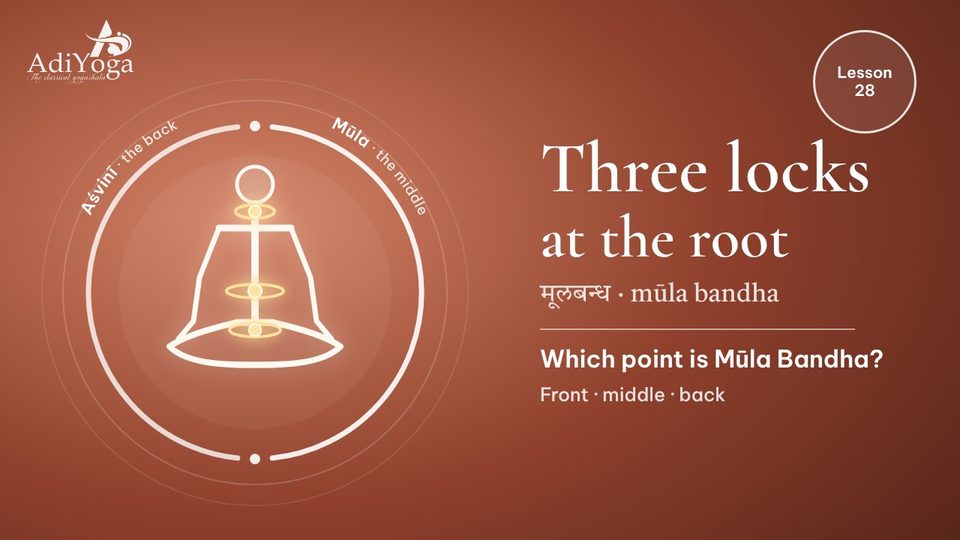
Your teacher says “engage Mūla Bandha”, but which point? The root region holds three different activations: one at the front, one in the middle and one at the back. At first they move together. Learning to feel them separately is the practice.
The yogis describe a downward-moving force in the body called apāna. Left to itself, it pulls energy down and out. The bandhas of the root region reverse this: they turn apāna upward, so that it can meet prāṇa and rise through the spine.
Without bandhas, āsana is just exercise. Bandhas turn posture into yoga.
Mūla Bandha · the middle. Mūla means root, bandha means lock. In men the point is the perineum, midway between the anus and the genitals; in women it is traditionally placed at the cervix. It is felt as a lift at the very centre of the pelvic floor, not at the front or the back.
Sahajolī and Vajrolī · the front. Sahaja means natural, vajra means thunderbolt. Sahajolī is the gentle front lock, safe for everyone to learn with care. Vajrolī is an advanced practice, passed from teacher to student.
Aśvinī Mudrā · the back. Aśva means horse: the horse contracts and releases its anal sphincter after evacuating. It is the easiest of the three to feel, and the traditional preparation for Mūla Bandha.
Learn them in this order: Aśvinī Mudrā (easiest to feel), then Sahajolī (front), then Mūla Bandha (the most subtle). Holding them with breath retention, or with Uḍḍiyāna and Jālandhara, is learned with a teacher.
Use little effort: 20 to 30% strength, not 100%. Release fully between rounds. If everything contracts at once, use less effort: subtle muscles respond to subtle effort.
Who should not practice: during pregnancy (unless guided), after recent abdominal or pelvic surgery, with acute haemorrhoids, a fissure or an active urinary or prostate infection, with pelvic pain or an already tight pelvic floor, or, with high blood pressure or heart conditions, together with breath retention. During menstruation keep to gentle awareness. Never force; if there is pain, stop.
पार्ष्णिभागेन सम्पीड्य योनिमाकुञ्चयेद्गुदम् । अपानमूर्ध्वमाकृष्य मूलबन्धोऽभिधीयते ॥pārṣṇibhāgena sampīḍya yonim ākuñcayed gudam · apānam ūrdhvam ākṛṣya mūlabandho ’bhidhīyate · Haṭha Yoga Pradīpikā 3.61Pressing the perineum with the heel, contract the anus and draw the apāna upward. This is called Mūla Bandha.
- 1 · Sahajolī · Vajrolī सहजोली
- Front: a gentle draw up and in at the urinary passage. Conserves vital energy and turns it upward.
- 2 · Mūla Bandha मूलबन्ध
- Middle: a small, central lift. The foundation: reverses apāna and supports every higher bandha.
- 3 · Aśvinī Mudrā अश्विनी मुद्रा
- Back: a ring-like squeeze and release of the anal sphincter. Tones the lower organs and prepares for Mūla Bandha.
The three-point scan: sit, close the eyes, and engage the front, then the middle, then the back, each on its own, resting between them.
A 10-minute practice: 2 min sit and breathe · 3 min Aśvinī Mudrā (20 slow, 30 quick) · 2 min Sahajolī (10 × 3–5 seconds) · 2 min Mūla Bandha (5–10 rounds of 5 breaths) · 1 min stillness.
Mūla Bandha means squeezing the buttocks hard.
It is a small, central lift at about 30% effort. The buttocks, thighs and belly stay soft and the breath stays free.
Use the “holding back urine” cue while urinating.
Use it only to find the muscles. Stopping the flow while urinating can stop the bladder from emptying fully.


Vuốt để xem tiếp ›
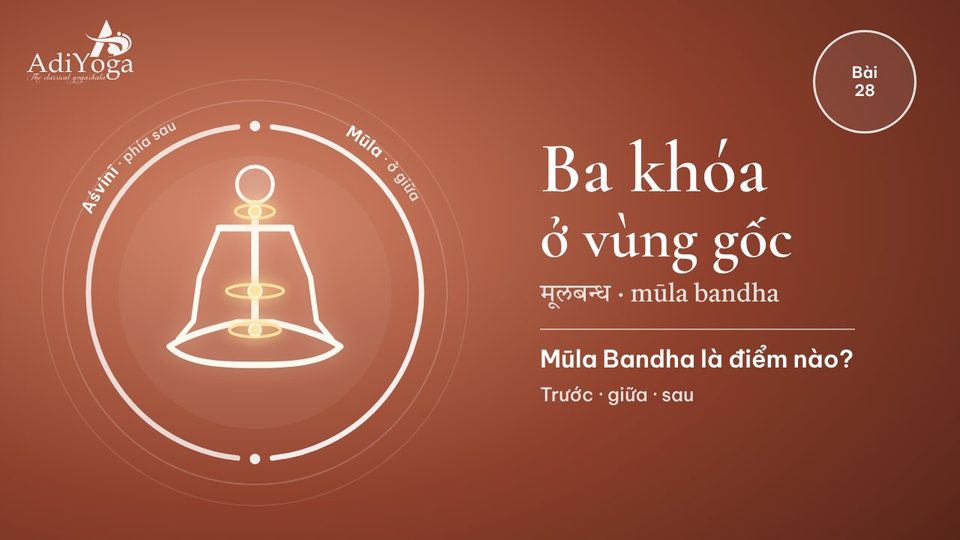
Thầy bảo “giữ Mūla Bandha”, nhưng là điểm nào? Vùng gốc có ba điểm kích hoạt khác nhau: một ở phía trước, một ở giữa và một ở phía sau. Lúc đầu chúng co cùng lúc. Học cách cảm nhận từng điểm riêng biệt chính là bài tập.
Các yogi mô tả một dòng năng lượng đi xuống trong cơ thể gọi là apāna. Nếu để tự nhiên, nó kéo năng lượng xuống và ra ngoài. Các bandha ở vùng gốc đảo ngược điều này: chúng hướng apāna lên trên, để nó gặp prāṇa và đi lên dọc cột sống.
Không có bandha, āsana chỉ là bài tập thể dục. Bandha biến tư thế thành yoga.
Mūla Bandha · ở giữa. Mūla là gốc, bandha là khóa. Ở nam, điểm này là đáy chậu, giữa hậu môn và bộ phận sinh dục; ở nữ, theo truyền thống là vùng cổ tử cung. Cảm nhận như một điểm nâng ở chính giữa sàn chậu, không phải phía trước hay phía sau.
Sahajolī và Vajrolī · phía trước. Sahaja là tự nhiên, vajra là sấm sét, kim cương. Sahajolī là khóa phía trước nhẹ nhàng, ai cũng có thể học một cách cẩn thận. Vajrolī là thực hành nâng cao, được truyền từ thầy sang trò.
Aśvinī Mudrā · phía sau. Aśva là con ngựa: con ngựa co và thả cơ vòng hậu môn sau khi bài tiết. Đây là điểm dễ cảm nhận nhất trong ba điểm, và là bước chuẩn bị truyền thống cho Mūla Bandha.
Học theo thứ tự này: Aśvinī Mudrā (dễ cảm nhận nhất), rồi Sahajolī (phía trước), rồi Mūla Bandha (vi tế nhất). Giữ các khóa cùng với nín thở, hoặc cùng Uḍḍiyāna và Jālandhara, cần học với thầy.
Dùng ít lực: 20 đến 30% sức, không phải 100%. Thả hoàn toàn giữa các vòng. Nếu mọi thứ co cùng lúc, hãy giảm lực: cơ vi tế đáp ứng với nỗ lực vi tế.
Ai không nên tập: khi mang thai (trừ khi có hướng dẫn), sau phẫu thuật vùng bụng hoặc vùng chậu gần đây, khi bị trĩ cấp, nứt hậu môn hoặc đang nhiễm trùng đường tiểu hay tuyến tiền liệt, khi đau vùng chậu hoặc sàn chậu vốn đã quá căng, hoặc khi bị huyết áp cao, bệnh tim mà kết hợp với nín thở. Trong kỳ kinh nguyệt chỉ giữ sự chú ý nhẹ nhàng. Không bao giờ ép; nếu đau, hãy dừng lại.
पार्ष्णिभागेन सम्पीड्य योनिमाकुञ्चयेद्गुदम् । अपानमूर्ध्वमाकृष्य मूलबन्धोऽभिधीयते ॥pārṣṇibhāgena sampīḍya yonim ākuñcayed gudam · apānam ūrdhvam ākṛṣya mūlabandho ’bhidhīyate · Haṭha Yoga Pradīpikā 3.61Dùng gót chân ép vào đáy chậu, co hậu môn và kéo apāna lên trên. Đó gọi là Mūla Bandha.
- 1 · Sahajolī · Vajrolī सहजोली
- Phía trước: kéo nhẹ lên và vào ở đường tiểu. Giữ gìn năng lượng sống và hướng nó lên trên.
- 2 · Mūla Bandha मूलबन्ध
- Ở giữa: một điểm nâng nhỏ ở trung tâm. Nền tảng: đảo chiều apāna và nâng đỡ mọi bandha cao hơn.
- 3 · Aśvinī Mudrā अश्विनी मुद्रा
- Phía sau: co và thả cơ vòng hậu môn. Làm săn chắc các cơ quan vùng dưới và chuẩn bị cho Mūla Bandha.
Quét ba điểm: ngồi, nhắm mắt, kích hoạt phía trước, rồi ở giữa, rồi phía sau, từng điểm riêng, nghỉ giữa các điểm.
Bài tập 10 phút: 2 phút ngồi và thở · 3 phút Aśvinī Mudrā (20 chậm, 30 nhanh) · 2 phút Sahajolī (10 lần × 3–5 giây) · 2 phút Mūla Bandha (5–10 vòng, mỗi vòng 5 hơi thở) · 1 phút tĩnh lặng.
Mūla Bandha là siết mạnh mông.
Đó là một điểm nâng nhỏ ở giữa, khoảng 30% lực. Mông, đùi và bụng vẫn mềm, hơi thở vẫn tự do.
Tập bằng cách nín tiểu khi đang đi tiểu.
Chỉ dùng hình ảnh “nín tiểu” để tìm cơ. Dừng dòng nước tiểu khi đang đi tiểu có thể khiến bàng quang không làm rỗng hoàn toàn.