 Adiyogashala
All about AUM: the sacred sound
Tất cả về AUM: âm thanh thiêng liêng


Swipe the pictures ›
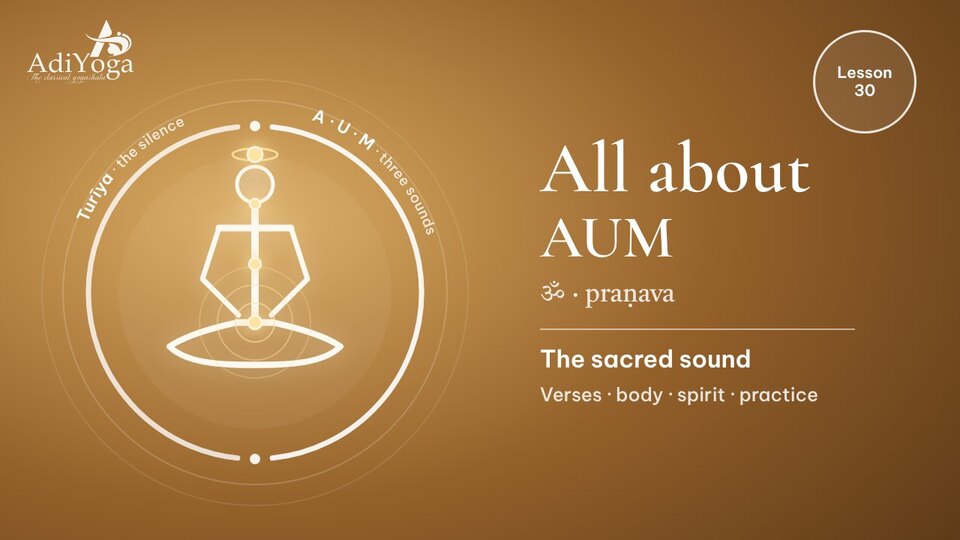
Most people chant AUM from the throat, quickly, to begin or end a class. But AUM is not one sound. It is three sounds and a silence, and each one rests in a different place in the body: A below the navel, U at the heart, M at the forehead, and the silence above the head.
AUM is written ॐ and is also spelled OM. In Sanskrit the vowels a and u merge into o, so AUM and OM are the same sound. Spelling it AUM shows the three parts that make it whole. The texts call it Praṇava (that which resounds), Oṅkāra, Akṣara (the syllable, and also the imperishable) and Ekākṣara, the one syllable.
Reading the symbol: the lower curve is A, the waking state; the right curve is U, the dream state; the upper curve is M, deep sleep. The crescent is the veil of māyā, and the dot is turīya, pure awareness. The dot does not touch the crescent: pure awareness is never touched by the veil.
A short history. AUM opens and closes every Vedic chant. The Māṇḍūkya Upaniṣad, only twelve verses long, is entirely about AUM. In the Bhagavad Gītā, Kṛṣṇa calls it the one syllable that is Brahman. Patañjali names it the sound of Īśvara. The haṭha yogis turned to nāda, inner sound. Om also appears in Buddhist and Jain chanting, and Sikh scripture opens with Ek Oṅkār.
Japa must go with bhāvanā, feeling the meaning. Mechanical chanting is only sound.
Why these places? Say A with the mouth open and feel the sound drop low into the belly. Round the lips into U and it rises into the chest. Close the lips into M and the hum moves into the head. The sound itself climbs the spine.
For the body: each chant stretches the exhalation to 10 seconds or more, which switches on the body’s rest-and-recover mode. The heart and nerves settle, the M hum vibrates and opens the sinuses, and the diaphragm, abdomen and ribs learn to work together, which helps prāṇāyāma. Chanting from below the navel, not the throat, builds a fuller, more relaxed voice.
What research has found: humming raised nasal nitric oxide about fifteen times compared with quiet breathing (Weitzberg & Lundberg, 2002). In an fMRI pilot study, chanting OM was linked with reduced activity in brain regions tied to emotion and stress, including the amygdala (Kalyani et al., 2011). Both are small studies: a beginning, not proof.
For the spirit: AUM gathers the scattered mind into one sound, then one point: ekāgratā. Sound is the doorway; the silence after the chant is the room. Patañjali promises awareness turned inward and the obstacles falling away. Moving from below the navel to above the head follows the path of the spine.
Practice safely: never strain the voice or the breath; if you feel dizzy, breathe normally and rest. Avoid practice right after a meal. With a sore throat, hum the M softly and skip the long A. With serious heart or lung conditions, practice gently and ask your doctor first.
ओमित्येतदक्षरमिदं सर्वं तस्योपव्याख्यानं भूतं भवद्भविष्यदिति सर्वमोङ्कार एव । यच्चान्यत्त्रिकालातीतं तदप्योङ्कार एव ॥om ity etad akṣaram idaṁ sarvaṁ tasyopavyākhyānaṁ bhūtaṁ bhavad bhaviṣyad iti sarvam oṅkāra eva · yac cānyat trikālātītaṁ tad apy oṅkāra eva · Māṇḍūkya Upaniṣad 1AUM, this syllable, is all this. All that was, all that is and all that will be is AUM. And whatever is beyond the three times, that too is AUM.
- A · below the navel अ
- Mouth open. The sound starts deep and low; feel the belly vibrate. Waking state, jāgrat.
- U · the heart उ
- Round the lips. The sound rises into the chest. Dreaming state, svapna.
- M · the forehead म
- Close the lips and hum. The sound fills the head. Deep sleep, suṣupti.
- Silence · above the head तुरीय
- The fourth, turīya: without parts, beyond all three. The real practice begins when the chanting stops.
One round: inhale fully through the nose, belly first, then chest (3–4 seconds) · A, about a quarter of the chant, attention below the navel · U, about a quarter, attention at the heart · M, about half, attention at the forehead · silence, as long as the chant, attention above the head · return with the next inhale.
How many rounds: beginners 3 rounds, then 2 minutes of silence · daily practice 7 or 11 rounds · deeper sādhana 21 or more, with a teacher. Fewer rounds with full attention are worth more than many done mechanically.
AUM is chanted from the throat.
It starts below the navel. A rests in the belly, U in the chest, M in the head.
The silence after AUM is just a pause.
The silence is the practice. Sound is the doorway, the silence is the room.
Louder is better.
AUM is resonant, not loud. Never force the voice.


Vuốt để xem tiếp ›
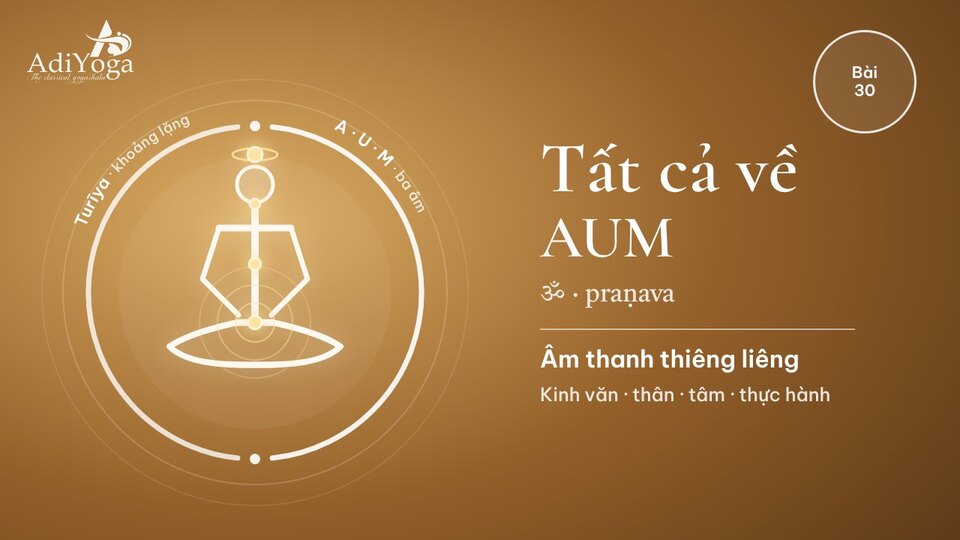
Hầu hết mọi người tụng AUM từ cổ họng, thật nhanh, để mở đầu hoặc kết thúc buổi tập. Nhưng AUM không phải một âm. Đó là ba âm và một khoảng lặng, và mỗi phần nằm ở một vị trí khác nhau trong cơ thể: A dưới rốn, U ở vùng tim, M ở trán, và khoảng lặng trên đỉnh đầu.
AUM được viết là ॐ, còn được viết là OM. Trong tiếng Phạn, hai nguyên âm a và u hợp lại thành o, nên AUM và OM là cùng một âm. Viết AUM giúp thấy rõ ba phần tạo nên âm này. Kinh văn gọi đó là Praṇava (âm vang lên), Oṅkāra, Akṣara (âm tiết, và cũng là cái bất diệt) và Ekākṣara, một âm tiết duy nhất.
Đọc biểu tượng: đường cong dưới là A, trạng thái thức; đường cong phải là U, trạng thái mơ; đường cong trên là M, giấc ngủ sâu. Vầng trăng là bức màn māyā, và dấu chấm là turīya, nhận biết thuần khiết. Dấu chấm không chạm vào vầng trăng: nhận biết thuần khiết không bao giờ bị bức màn chạm tới.
Lịch sử ngắn gọn. AUM mở đầu và kết thúc mọi bài tụng Veda. Māṇḍūkya Upaniṣad chỉ có mười hai câu và hoàn toàn nói về AUM. Trong Bhagavad Gītā, Kṛṣṇa gọi đó là âm tiết duy nhất chính là Brahman. Patañjali gọi đó là âm thanh của Īśvara. Các yogi haṭha hướng đến nāda, âm thanh bên trong. Om cũng xuất hiện trong kinh tụng Phật giáo và Kỳ Na giáo, và kinh điển đạo Sikh mở đầu bằng Ek Oṅkār.
Japa phải đi cùng bhāvanā, cảm nhận ý nghĩa. Tụng một cách máy móc chỉ là âm thanh.
Vì sao lại là những vị trí này? Hãy nói A với miệng mở và cảm nhận âm thanh rơi xuống bụng. Tròn môi thành U và âm thanh dâng lên ngực. Khép môi thành M và tiếng ngân di chuyển lên đầu. Chính âm thanh leo lên theo cột sống.
Cho cơ thể: mỗi lần tụng kéo dài hơi thở ra đến 10 giây hoặc hơn, kích hoạt chế độ nghỉ ngơi và phục hồi của cơ thể. Tim và thần kinh dịu lại, tiếng ngân M làm rung và thông xoang, cơ hoành, bụng và lồng ngực học cách phối hợp với nhau, hỗ trợ cho prāṇāyāma. Tụng từ dưới rốn chứ không từ cổ họng giúp giọng nói đầy đặn và thư giãn hơn.
Nghiên cứu cho thấy gì: ngân nga làm tăng nitric oxide trong mũi khoảng mười lăm lần so với thở bình thường (Weitzberg & Lundberg, 2002). Trong một nghiên cứu fMRI thử nghiệm, tụng OM liên quan đến việc giảm hoạt động ở các vùng não gắn với cảm xúc và căng thẳng, gồm cả hạch hạnh nhân (Kalyani và cộng sự, 2011). Cả hai đều là nghiên cứu nhỏ: mới là khởi đầu, chưa phải bằng chứng.
Cho tâm linh: AUM gom tâm trí tản mát về một âm thanh, rồi một điểm: ekāgratā. Âm thanh là cánh cửa; khoảng lặng sau khi tụng là căn phòng. Patañjali hứa hẹn nhận biết quay vào bên trong và các chướng ngại tan biến. Di chuyển từ dưới rốn lên trên đỉnh đầu đi theo đường cột sống.
Tập an toàn: không bao giờ ép giọng hay hơi thở; nếu thấy chóng mặt, hãy thở bình thường và nghỉ. Tránh tập ngay sau bữa ăn. Khi đau họng, chỉ ngân M nhẹ nhàng và bỏ âm A dài. Khi có bệnh tim hoặc phổi nặng, hãy tập nhẹ nhàng và hỏi bác sĩ trước.
ओमित्येतदक्षरमिदं सर्वं तस्योपव्याख्यानं भूतं भवद्भविष्यदिति सर्वमोङ्कार एव । यच्चान्यत्त्रिकालातीतं तदप्योङ्कार एव ॥om ity etad akṣaram idaṁ sarvaṁ tasyopavyākhyānaṁ bhūtaṁ bhavad bhaviṣyad iti sarvam oṅkāra eva · yac cānyat trikālātītaṁ tad apy oṅkāra eva · Māṇḍūkya Upaniṣad 1AUM, âm tiết này, là tất cả. Tất cả những gì đã có, đang có và sẽ có đều là AUM. Và những gì vượt ngoài ba thời, cũng là AUM.
- A · below the navel अ
- Mở miệng. Âm thanh bắt đầu sâu và thấp; cảm nhận bụng rung. Trạng thái thức, jāgrat.
- U · the heart उ
- Tròn môi. Âm thanh dâng lên ngực. Trạng thái mơ, svapna.
- M · the forehead म
- Khép môi và ngân. Âm thanh lan khắp đầu. Ngủ sâu, suṣupti.
- Silence · above the head तुरीय
- Trạng thái thứ tư, turīya: không có phần nào, vượt trên cả ba. Thực hành thật sự bắt đầu khi tiếng tụng dừng lại.
Một vòng: hít vào đầy qua mũi, bụng trước rồi đến ngực (3–4 giây) · A, khoảng ¼ thời gian tụng, chú ý dưới rốn · U, khoảng ¼, chú ý ở vùng tim · M, khoảng ½, chú ý ở trán · tĩnh lặng, dài bằng lần tụng, chú ý trên đỉnh đầu · trở về với hơi hít vào tiếp theo.
Bao nhiêu vòng: người mới 3 vòng, rồi 2 phút tĩnh lặng · tập hằng ngày 7 hoặc 11 vòng · sādhana sâu hơn 21 vòng trở lên, có thầy hướng dẫn. Ít vòng với sự chú tâm trọn vẹn quý hơn nhiều vòng tụng máy móc.
AUM được tụng từ cổ họng.
Âm thanh bắt đầu dưới rốn. A ở bụng, U ở ngực, M ở đầu.
Khoảng lặng sau AUM chỉ là lúc nghỉ.
Khoảng lặng chính là bài tập. Âm thanh là cánh cửa, khoảng lặng là căn phòng.
Tụng càng to càng tốt.
AUM là âm vang, không phải âm to. Không bao giờ ép giọng.