 Adiyogashala
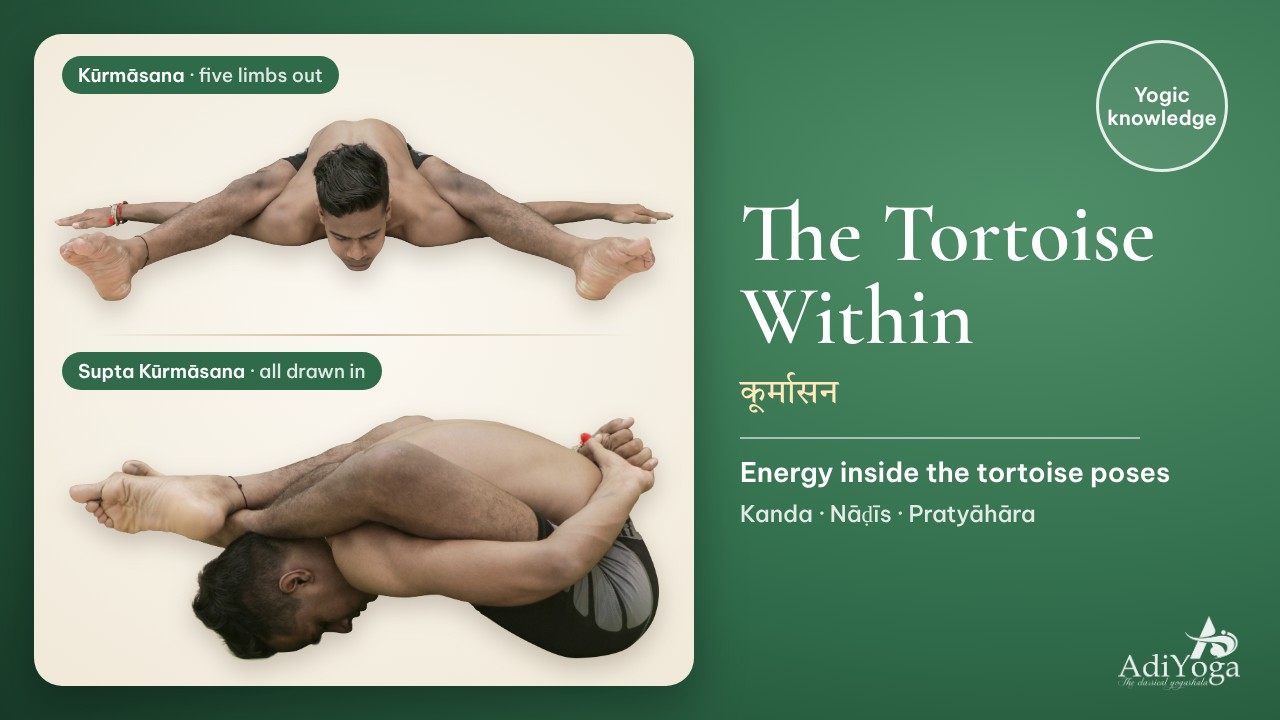
The Tortoise Within · Kūrmāsana
Kūrmāsana & Supta Kūrmāsana: what really happens inside the tortoise postures
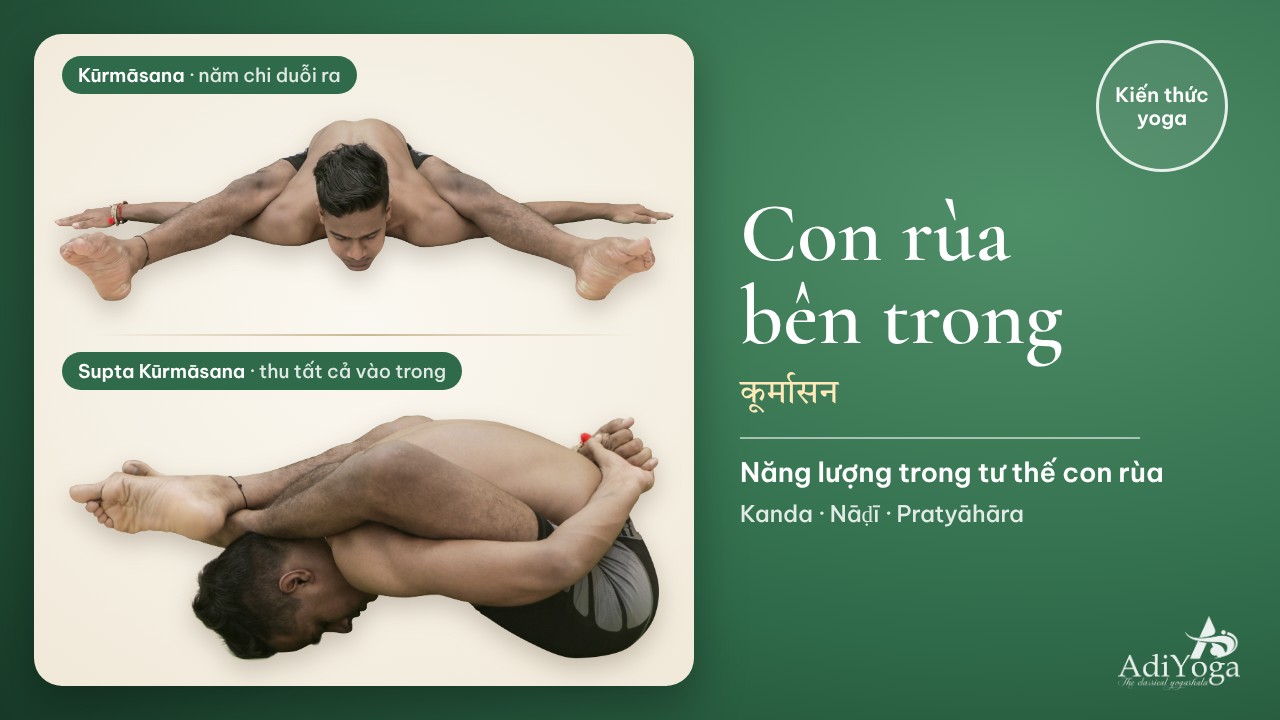
Con rùa bên trong · Kūrmāsana
Kūrmāsana & Supta Kūrmāsana: điều thực sự xảy ra bên trong các tư thế con rùa
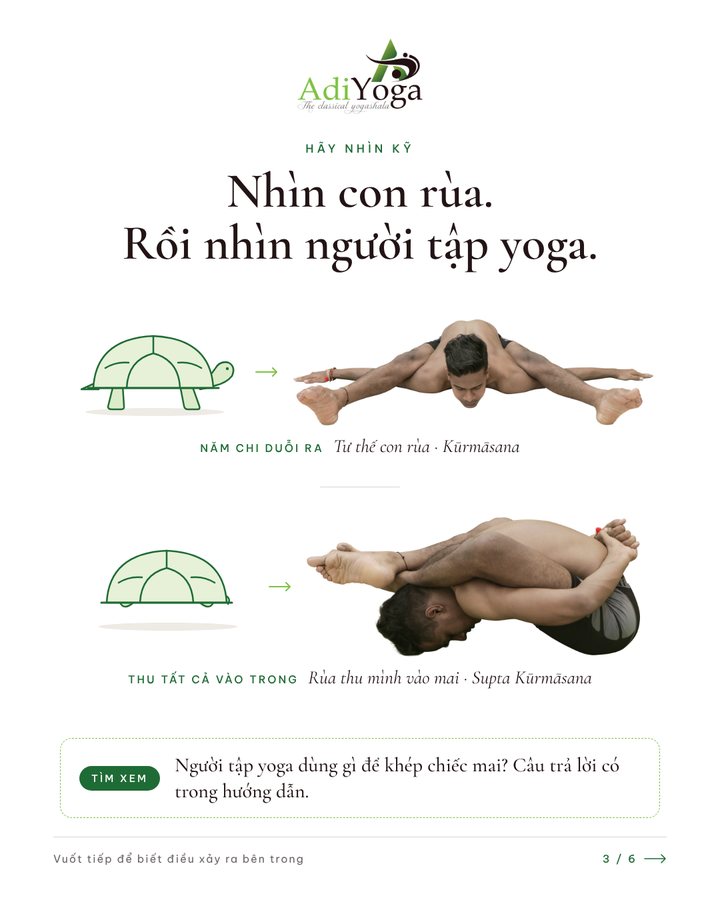
Why the tortoise?
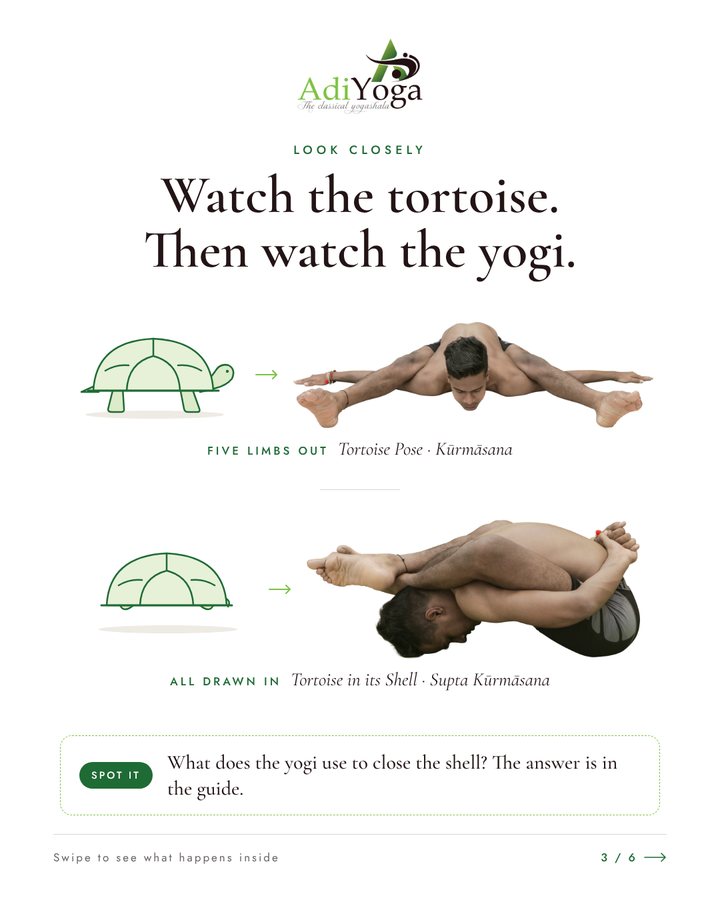
For thousands of years, yogis have watched the tortoise. When it senses danger, it does not run. It simply draws its head and four limbs into its shell and becomes still: protected, and fully aware.
The Bhagavad Gītā uses the same image: when a person withdraws the senses from their objects, as a tortoise draws in its limbs on every side, their wisdom becomes steady (2.58).
Hatha Yoga turns this image into a practice. Two postures carry the tortoise’s name, and together they form a journey from the outside in.
What the ancient text says
kūrmāsanaṁ bhaved etad iti yogavido viduḥHaṭha Yoga Pradīpikā · 1.22
| gudam | the anus, the base of the body |
| nirudhya | pressing, closing |
| gulphābhyām | with both ankles |
| vyutkrameṇa | crossed, in reverse order |
| samāhitaḥ | steady, composed, collected |
| kūrmāsanam | the tortoise posture |
| bhaved etad | this becomes |
| iti yogavido viduḥ | so the knowers of yoga say |
Pressing the base of the body firmly with the ankles crossed in reverse, and sitting steady and composed: this is Kūrmāsana, say the knowers of yoga.
The verse is short, but notice where it begins: at the base. The crossed ankles press and seal the root of the body, the place where energy tends to drain downward and outward. Before the tortoise can draw its senses in, it must first close the bottom of its shell.
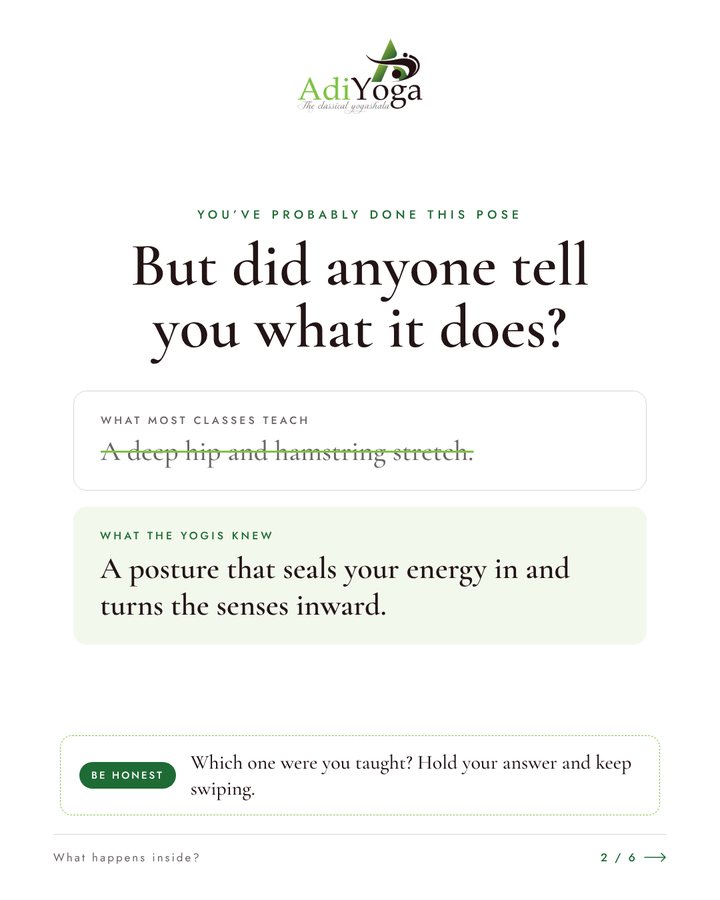
In the forms practiced today, the same principle is expressed through the whole body. The posture first seals the base, then gradually turns every limb, and every sense, inward. This is why Kūrmāsana is described not as a stretch, but as a state: samāhitaḥ, collected and steady.
Tortoise Pose · Kūrmāsana · five limbs out
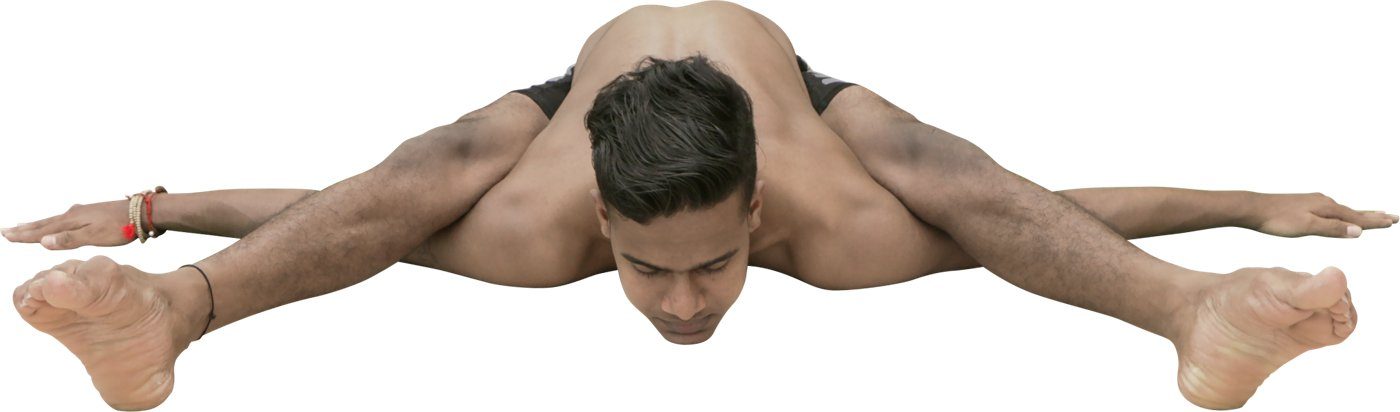
Sit with the legs wide, a little wider than the hips. Bend the knees slightly.
Fold forward from the hips with a long spine, and slide the arms under the knees.
Extend the arms out to the sides, palms down, with the backs of the knees resting on the upper arms and shoulders.
Slowly straighten the legs, pushing out through the heels. The legs press the shoulders down and the chest moves toward the floor.
Rest the chin or forehead on the floor. Let the breath become slow, deep and even.
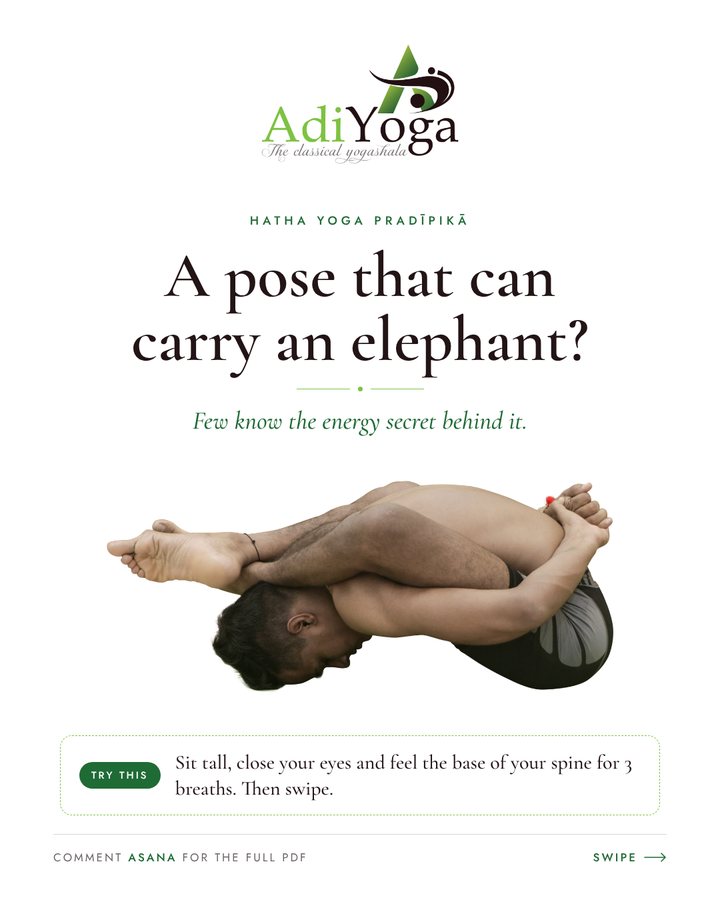
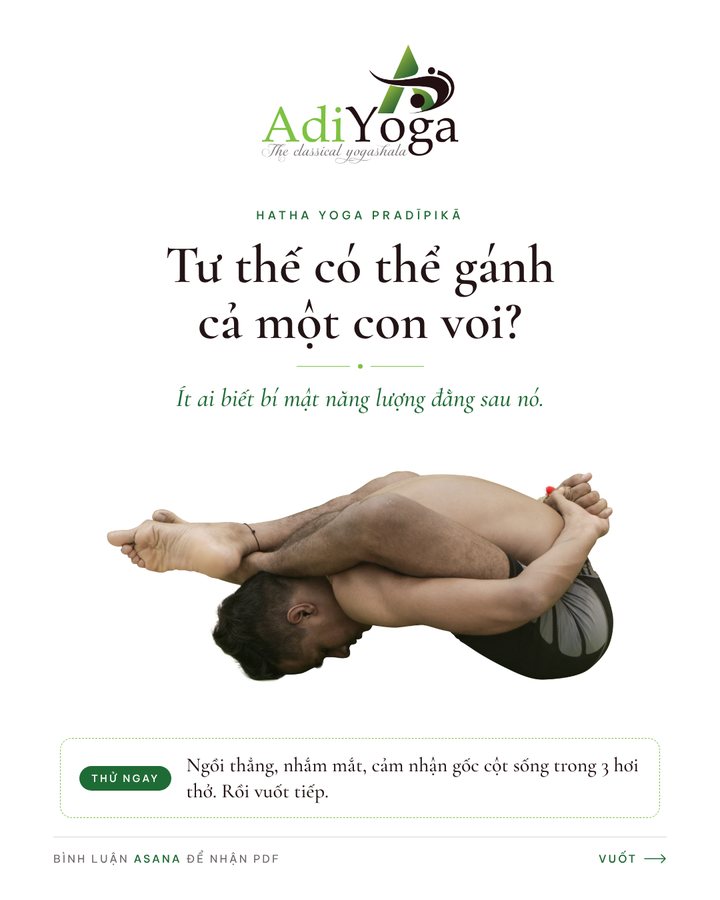
Tortoise in its Shell · Supta Kūrmāsana · all drawn in
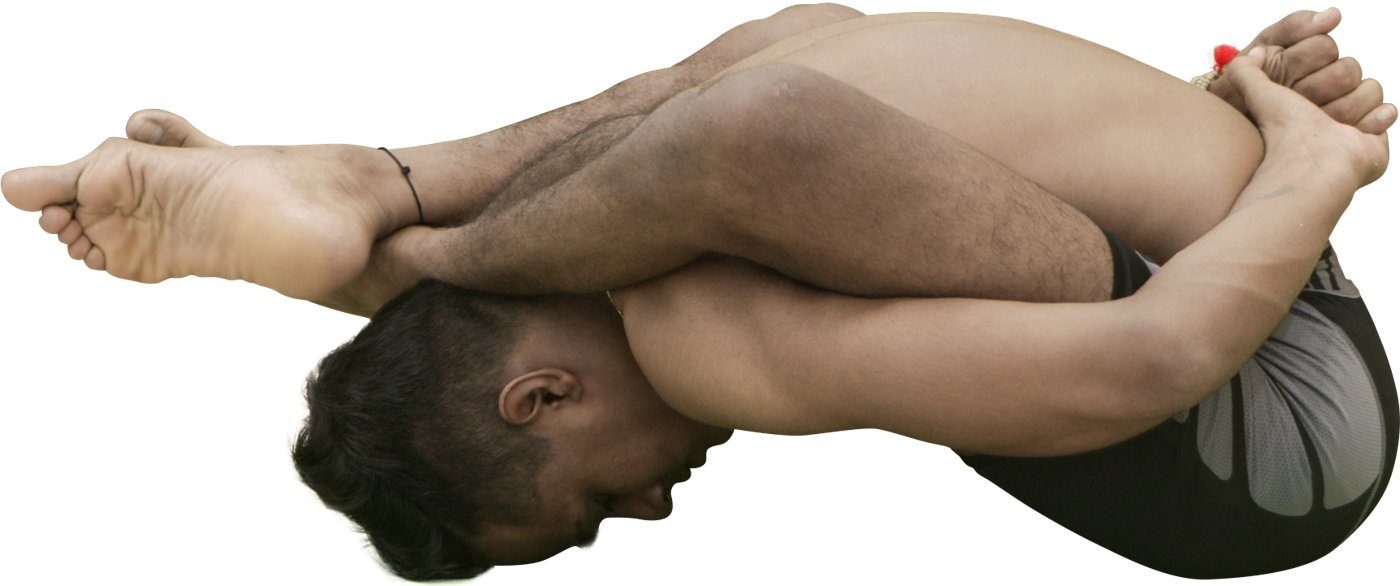
From Tortoise Pose, bend the knees and draw the feet toward each other in front of the head.
Take the arms behind the back. Let one hand catch the other wrist: this is Maṇi bandha, the wrist lock.
Cross the ankles. Over time and with patience, draw the crossed ankles back behind the neck.
Let the head settle beneath the legs, the whole body folded into itself.
Rest the attention on the tip of the nose and on the breath. Stay for 5 breaths.
Release the wrists first, uncross the ankles slowly, and sit up.
- Supta Kūrmāsana is an advanced posture. Never force the legs behind the head. Build hip and spine flexibility over time, ideally under the guidance of an experienced teacher.
What it does for the body
Before it works on energy, the tortoise works on the body, and the body feels it immediately.
Kūrmāsana expands the thorax and increases the capacity of the lungs, bringing more oxygenated blood to the heart and lungs.
The long, even fold strengthens the spine and the region of the spinal cord, from the base to the neck.
The deep fold works the whole back body and is traditionally said to strengthen the kidneys and ease kidney pain.
In Āyurveda, the posture helps balance Kapha dosha and reduce excess fat.
Folding inward with slow breathing calms the nervous system and quiets the mind.
Yogic texts traditionally recommend this posture for those with heart conditions, chest pain, asthma and bronchitis. Practice it as support for health, alongside medical care, never in place of it.
The Kanda: root of 72,000 nāḍīs
In yogic anatomy, the body is a network of 72,000 nāḍīs, channels of energy that closely relate to our nerves. They all arise from one place: the Kanda, a bulb-shaped centre at the base of the spine.
The Kanda lies where the spinal cord gives way to the nerves that branch out into the body: the junction where the central nervous system meets the peripheral nervous system. Both tortoise postures fold the body over this point and stimulate it directly.
“Kuṇḍalinī sleeps above the Kanda. This Śakti is the means of liberation for the yogi, and bondage for the ignorant. One who knows this is the knower of yoga.”— Haṭha Yoga Pradīpikā
This is why the tortoise postures are more than a stretch. By working at the Kanda, they touch the very root from which the whole energy system grows. A practice that reaches the root nourishes every branch.
Every point is a junction
In Hatha Yoga the joints are sandhis: junctions where energy gathers. In Supta Kūrmāsana, three of them are pressed and connected at once.
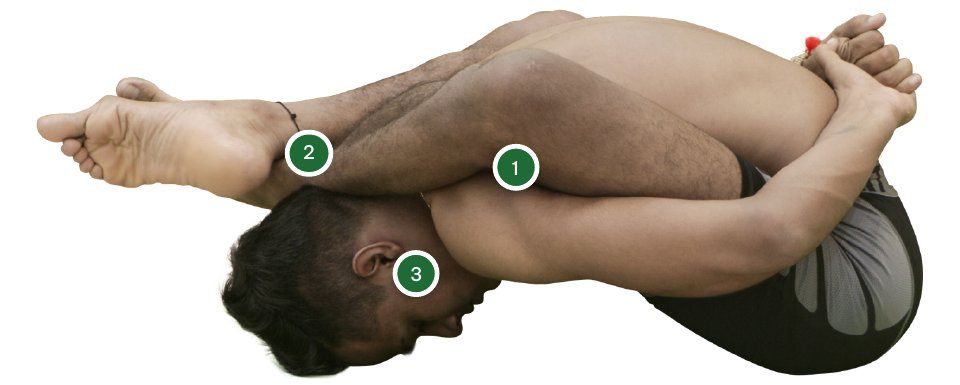
The backs of the knees rest on top of the shoulders. The energy junctions of the legs and the arms press together and connect, joining the lower and upper body into one circuit.
The crossed ankles press behind the neck, on the region of Viśuddhi, the throat centre. Viśuddhi means purification; steady pressure here is said to awaken and stabilise it.
The vagus nerve runs from the brainstem through the neck to the heart, lungs and digestive organs, and is central to the body’s rest-and-restore response. A deep fold with long, slow exhalations encourages this response, which is why the posture leaves the mind quiet and settled.
Mudrā, bandha and dṛṣṭi
A tortoise is safe because its shell is sealed. In these postures, the body becomes the shell: the bound hands act as a mudrā, and every joint becomes a bandha, a lock that keeps the energy within.
In Supta Kūrmāsana, one hand catches the other wrist behind the back, closing the circuit of the arms like a mudrā.
The shoulders lock under the knees, holding the fold steady and pressing the energy junctions of the arms.
The crossed ankles lock behind the neck and close the shell from above.
Where the eyes go, attention goes. Where attention goes, energy flows. The dṛṣṭi is the final seal.
Strong enough to carry an elephant
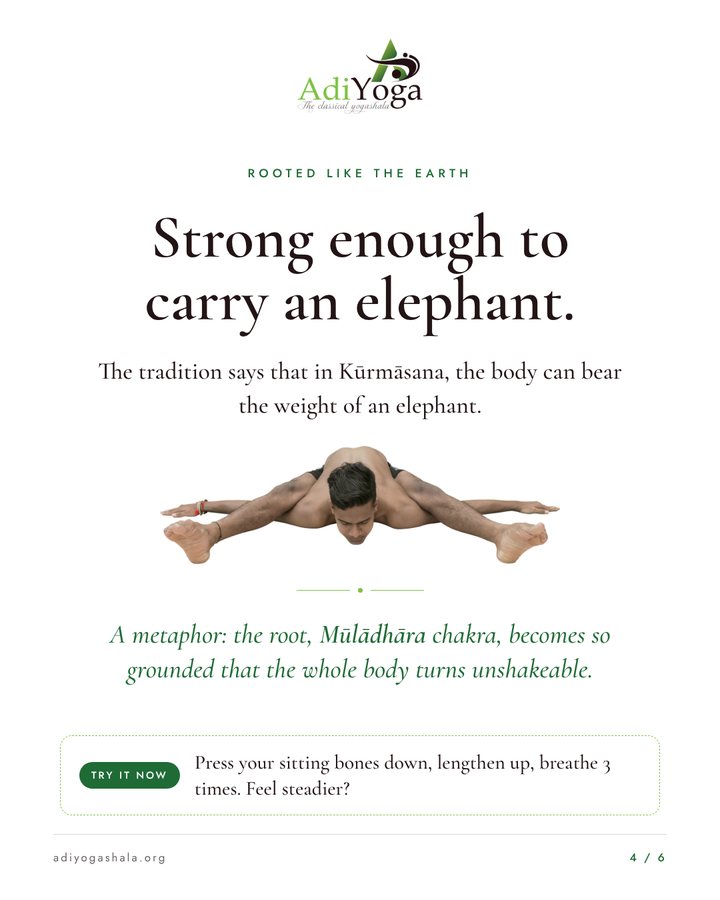
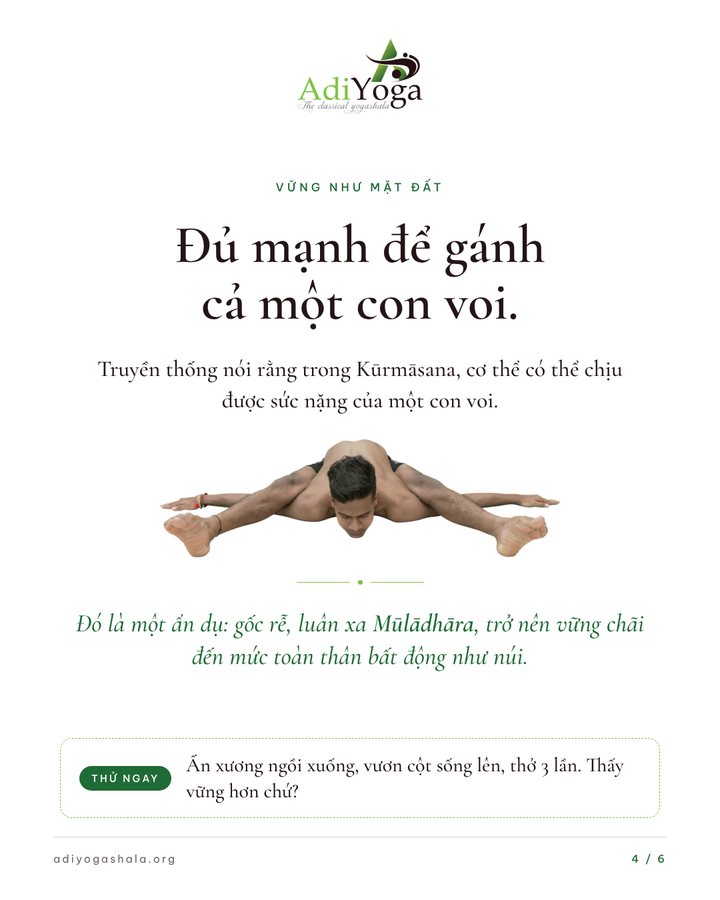
It is said that in Kūrmāsana the body can bear the weight of an elephant.
This is a metaphor, not a challenge. When the base is sealed and Mūlādhāra, the root chakra, becomes deeply grounded, the whole body becomes stable and unshakeable, like the earth itself.
From the body to Pratyāhāra
Pratyāhāra, the fifth limb of Patañjali’s yoga, means withdrawal of the senses. Its purpose is to quiet the outward pull of the mind, so that concentration becomes possible.
When the tortoise retreats into its shell, it pulls in its five senses (the eyes, ears, nose, mouth and limbs) yet remains aware of everything outside. Supta Kūrmāsana is the body’s way of learning this.
A practice for the inner tortoise
Once settled in the posture, soften the eyes and rest the gaze at the tip of the nose.
Notice the sounds around you, then let them go without following them.
Notice the touch of the floor, then let it fade into the background.
Rest in the breath. Stay aware, but do not reach out.
After 5 breaths, come out slowly and keep that inward quality as you sit.
Practice with care
The tortoise is never in a hurry. Approach these postures the same way: steadily, over weeks and months.
Baddha Koṇāsana · Wide-leg forward fold (Upaviṣṭha Koṇāsana) · Seated forward fold (Paścimottānāsana) · Gentle hip openers
Upward plank (Pūrvottānāsana) · A gentle backbend · Rest in Śavāsana
- Avoid or modify if you have a lower back or disc injury
- … a hamstring, shoulder or neck injury
- … are pregnant
- … had recent abdominal surgery
“Yoga is not an option, it is a necessity. Asana can be an option.”— Master Girish, Founder, Adiyogashala
Vì sao lại là con rùa?
Hàng nghìn năm qua, các yogi đã quan sát con rùa. Khi cảm thấy nguy hiểm, nó không chạy trốn. Nó chỉ thu đầu và bốn chân vào trong mai rồi tĩnh lặng: được bảo vệ, và hoàn toàn tỉnh thức.
Bhagavad Gītā dùng cùng hình ảnh này: khi một người rút các giác quan khỏi đối tượng của chúng, như con rùa thu tứ chi vào từ mọi phía, trí tuệ của người ấy trở nên vững vàng (2.58).
Hatha Yoga biến hình ảnh này thành sự thực hành. Hai tư thế mang tên con rùa, và cùng nhau tạo thành một hành trình từ ngoài vào trong.
Kinh điển cổ xưa nói gì
kūrmāsanaṁ bhaved etad iti yogavido viduḥHaṭha Yoga Pradīpikā · 1.22
| gudam | hậu môn, phần gốc của cơ thể |
| nirudhya | ép chặt, đóng lại |
| gulphābhyām | bằng hai mắt cá chân |
| vyutkrameṇa | bắt chéo, theo thứ tự ngược |
| samāhitaḥ | vững vàng, an định, thu nhiếp |
| kūrmāsanam | tư thế con rùa |
| bhaved etad | đây chính là |
| iti yogavido viduḥ | các bậc hiểu biết về yoga nói như vậy |
Dùng hai mắt cá chân bắt chéo ép chặt vào gốc cơ thể và ngồi vững vàng, an định: đó là Kūrmāsana, như các bậc hiểu biết về yoga đã nói.
Câu kinh rất ngắn, nhưng hãy để ý nơi nó bắt đầu: ở phần gốc. Hai mắt cá chân bắt chéo ép và niêm phong gốc rễ của cơ thể, nơi năng lượng có xu hướng thoát xuống dưới và ra ngoài. Trước khi con rùa có thể thu các giác quan vào trong, nó phải đóng phần đáy của chiếc mai trước.
Trong các hình thức được thực hành ngày nay, cùng một nguyên lý được thể hiện qua toàn bộ cơ thể. Tư thế trước hết niêm phong phần gốc, rồi dần dần đưa mọi chi, và mọi giác quan, quay vào trong. Vì vậy Kūrmāsana không được mô tả như một động tác kéo giãn, mà như một trạng thái: samāhitaḥ, thu nhiếp và vững vàng.
Tư thế con rùa · Kūrmāsana · năm chi duỗi ra
Ngồi dang rộng hai chân, rộng hơn hông một chút. Hơi co nhẹ đầu gối.
Gập người về phía trước từ hông, giữ cột sống dài, luồn hai tay dưới đầu gối.
Duỗi hai tay sang hai bên, lòng bàn tay úp xuống, mặt sau đầu gối tựa lên cánh tay trên và vai.
Từ từ duỗi thẳng chân, đẩy ra qua gót chân. Chân ép vai xuống và ngực tiến dần về phía sàn.
Đặt cằm hoặc trán xuống sàn. Để hơi thở trở nên chậm, sâu và đều.
Rùa thu mình vào mai · Supta Kūrmāsana · thu tất cả vào trong
Từ tư thế con rùa, co gối và đưa hai bàn chân lại gần nhau phía trước đầu.
Đưa hai tay ra sau lưng. Để một tay nắm lấy cổ tay kia: đây là Maṇi bandha, khóa cổ tay.
Bắt chéo hai mắt cá chân. Theo thời gian và với sự kiên nhẫn, đưa hai mắt cá chân bắt chéo ra sau gáy.
Để đầu nằm yên bên dưới hai chân, toàn thân gập trọn vào trong chính mình.
Đặt sự chú ý vào chóp mũi và vào hơi thở. Giữ trong 5 hơi thở.
Thả cổ tay trước, từ từ gỡ chéo mắt cá chân, rồi ngồi dậy.
- Supta Kūrmāsana là tư thế nâng cao. Không bao giờ ép chân ra sau đầu. Hãy xây dựng độ linh hoạt của hông và cột sống theo thời gian, tốt nhất là dưới sự hướng dẫn của giáo viên có kinh nghiệm.
Lợi ích cho cơ thể
Trước khi tác động lên năng lượng, tư thế con rùa tác động lên cơ thể, và cơ thể cảm nhận được ngay.
Kūrmāsana mở rộng lồng ngực và tăng dung tích phổi, đưa nhiều máu giàu oxy hơn đến tim và phổi.
Thế gập dài và đều làm khỏe cột sống và vùng tủy sống, từ gốc lên đến cổ.
Thế gập sâu tác động lên toàn bộ mặt sau cơ thể và theo truyền thống được cho là làm khỏe thận, giảm đau thận.
Theo Āyurveda, tư thế giúp cân bằng Kapha dosha và giảm mỡ thừa.
Gập vào trong cùng hơi thở chậm làm dịu hệ thần kinh và làm lắng tâm trí.
Các kinh điển yoga theo truyền thống khuyên dùng tư thế này cho người có bệnh tim, đau ngực, hen suyễn và viêm phế quản. Hãy thực hành như một sự hỗ trợ cho sức khỏe, song song với chăm sóc y tế, không bao giờ thay thế nó.
Kanda: gốc rễ của 72.000 nāḍī
Theo giải phẫu học yoga, cơ thể là một mạng lưới gồm 72.000 nāḍī, những kênh năng lượng liên hệ mật thiết với dây thần kinh. Tất cả đều khởi nguồn từ một nơi: Kanda, một trung tâm hình củ ở gốc cột sống.
Kanda nằm ở nơi tủy sống chuyển tiếp thành các dây thần kinh tỏa ra khắp cơ thể: điểm giao nơi hệ thần kinh trung ương gặp hệ thần kinh ngoại biên. Cả hai tư thế con rùa đều gập cơ thể qua điểm này và kích thích trực tiếp vào nó.
“Kuṇḍalinī ngủ phía trên Kanda. Năng lượng Śakti này là phương tiện giải thoát cho hành giả yoga, và là sự trói buộc cho kẻ vô minh. Người biết điều này là người hiểu yoga.”— Haṭha Yoga Pradīpikā
Đây là lý do các tư thế con rùa không chỉ là kéo giãn. Khi tác động vào Kanda, chúng chạm đến chính gốc rễ nơi toàn bộ hệ năng lượng phát triển. Một sự thực hành chạm tới gốc rễ sẽ nuôi dưỡng mọi nhánh cành.
Mỗi điểm là một nút năng lượng
Trong Hatha Yoga, các khớp là sandhi: những điểm giao nơi năng lượng tụ lại. Trong Supta Kūrmāsana, ba điểm được ép và kết nối cùng một lúc.
Mặt sau đầu gối tựa lên đỉnh vai. Các điểm giao năng lượng của chân và tay ép vào nhau và kết nối, nối phần thân dưới và thân trên thành một mạch.
Hai mắt cá chân bắt chéo ép sau gáy, lên vùng Viśuddhi, trung tâm cổ họng. Viśuddhi nghĩa là sự thanh lọc; áp lực đều đặn ở đây được cho là đánh thức và ổn định luân xa này.
Dây thần kinh phế vị chạy từ thân não qua cổ đến tim, phổi và các cơ quan tiêu hóa, và đóng vai trò trung tâm trong phản ứng nghỉ ngơi và hồi phục của cơ thể. Một thế gập sâu với hơi thở ra dài và chậm khuyến khích phản ứng này, vì vậy tư thế để lại cho tâm trí sự yên tĩnh và lắng đọng.
Mudrā, bandha và dṛṣṭi
Con rùa an toàn vì chiếc mai của nó được khép kín. Trong các tư thế này, cơ thể trở thành chiếc mai: đôi tay khóa lại đóng vai trò như một mudrā, và mỗi khớp trở thành một bandha, một khóa giữ năng lượng bên trong.
Trong Supta Kūrmāsana, một tay nắm lấy cổ tay kia sau lưng, khép kín mạch của hai tay như một mudrā.
Hai vai khóa dưới đầu gối, giữ thế gập vững vàng và ép vào các điểm giao năng lượng của tay.
Hai mắt cá chân bắt chéo khóa sau gáy và khép kín chiếc mai từ phía trên.
Mắt hướng đến đâu, sự chú ý đến đó. Sự chú ý đến đâu, năng lượng chảy đến đó. Dṛṣṭi là lớp niêm phong cuối cùng.
Đủ mạnh để gánh cả một con voi
Người ta nói rằng trong Kūrmāsana, cơ thể có thể chịu được sức nặng của một con voi.
Đây là một ẩn dụ, không phải một thử thách. Khi phần gốc được niêm phong và Mūlādhāra, luân xa gốc, trở nên vững chãi sâu sắc, toàn thân trở nên ổn định và bất động như chính mặt đất.
Từ cơ thể đến Pratyāhāra
Pratyāhāra, chi thứ năm trong yoga của Patañjali, nghĩa là sự thu nhiếp các giác quan. Mục đích của nó là làm lắng lực kéo hướng ngoại của tâm trí, để sự tập trung trở nên khả thi.
Khi con rùa rút vào mai, nó thu năm giác quan vào trong (mắt, tai, mũi, miệng và tứ chi) nhưng vẫn tỉnh thức với mọi thứ bên ngoài. Supta Kūrmāsana là cách cơ thể học điều này.
Thực hành cho con rùa bên trong
Khi đã ổn định trong tư thế, làm mềm đôi mắt và đặt ánh nhìn ở chóp mũi.
Nhận biết các âm thanh xung quanh, rồi buông chúng đi mà không chạy theo.
Nhận biết sự tiếp xúc với sàn, rồi để nó lùi dần vào nền.
Nghỉ ngơi trong hơi thở. Vẫn tỉnh thức, nhưng không vươn ra ngoài.
Sau 5 hơi thở, từ từ ra khỏi tư thế và giữ phẩm chất hướng nội ấy khi ngồi.
Thực hành cẩn trọng
Con rùa không bao giờ vội vàng. Hãy tiếp cận các tư thế này theo cùng cách đó: đều đặn, qua nhiều tuần và nhiều tháng.
Baddha Koṇāsana · Gập người dang chân rộng (Upaviṣṭha Koṇāsana) · Gập người ngồi (Paścimottānāsana) · Các bài mở hông nhẹ nhàng
Plank ngửa (Pūrvottānāsana) · Một tư thế ngả sau nhẹ nhàng · Nghỉ trong Śavāsana
- Tránh hoặc điều chỉnh nếu bị chấn thương lưng dưới hoặc đĩa đệm
- … chấn thương gân kheo, vai hoặc cổ
- … đang mang thai
- … mới phẫu thuật vùng bụng
“Yoga không phải là một lựa chọn, mà là một điều cần thiết. Asana có thể là một lựa chọn.”— Master Girish, Người sáng lập Adiyogashala
Start your daily practice
Yoga, breathing and meditation at home, with guidance from Adiyogashala.
Bắt đầu luyện tập mỗi ngày
Yoga, hơi thở và thiền tại nhà, với sự hướng dẫn của Adiyogashala.